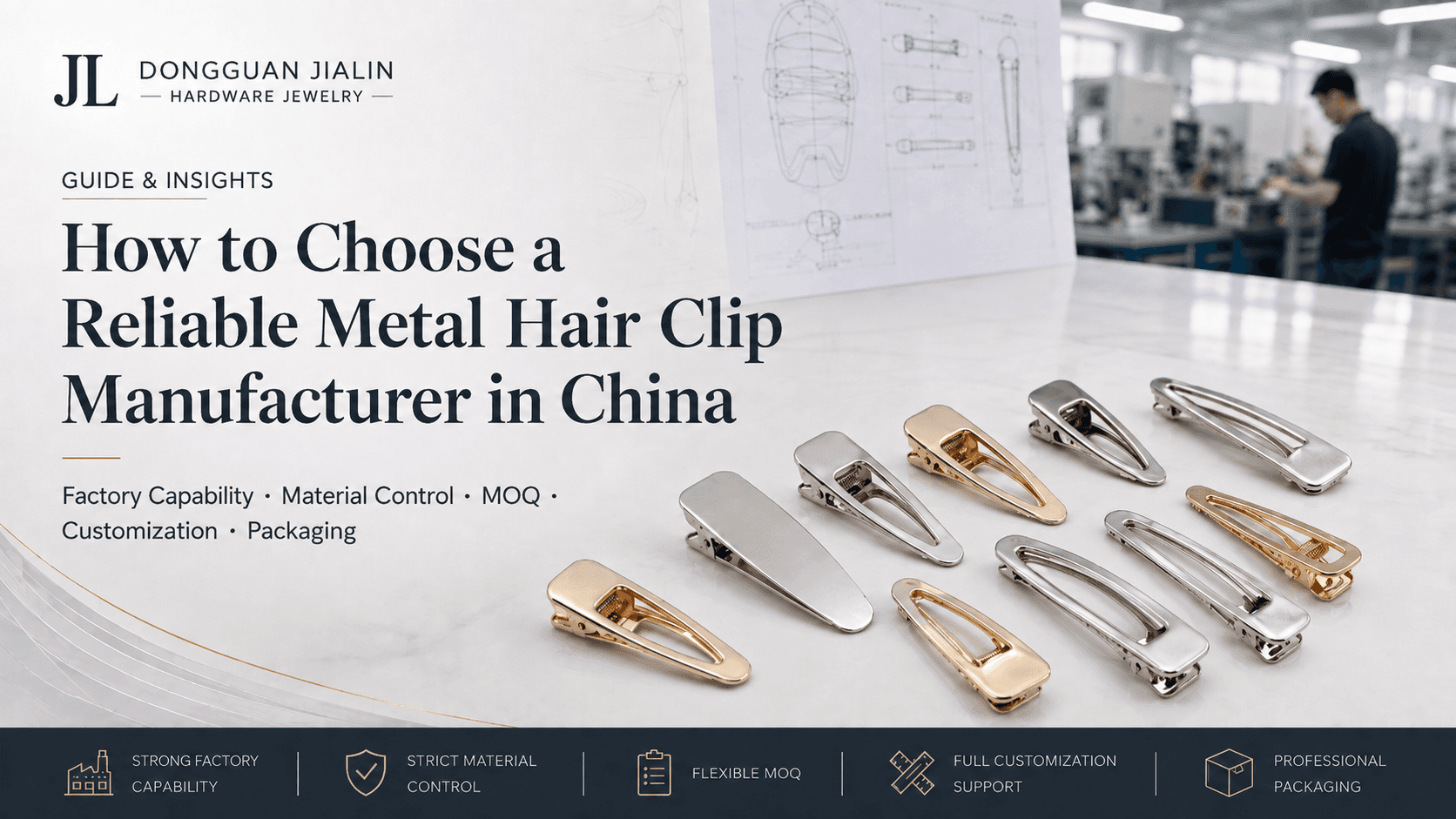
How to make hairpin

Making a hairpin usually includes the following process steps and material processing. The following describes the basic production process of a metal hairpin. (The process of plastic or composite hairpins may be slightly different).
1. Design and mold making
Design: Draw the shape and functional design of the hairpin through design software, including size, decorative parts, elastic structure, etc.
Mold making: According to the design, make metal or plastic molds for subsequent molding processes.


2. Material preparation
Metal hairpins: Usually stainless steel, aluminum alloy or iron materials are used because of their high strength, good elasticity and strong rust resistance.
Plastic hairpins: Polypropylene (PP), polystyrene (PS) and other plastic particles are mostly used.
Decorative materials: may include fabric, beads, rhinestones, etc.

3. Stamping and cutting
Metal hairpins: Use stamping equipment to process metal sheets into the desired hairpin shape.
Cut the excess edges to ensure the accuracy of size and shape.
Plastic hairpins: The plastic raw materials are injected into the mold after being melted at high temperature through the injection molding process.

4. Polishing and treatment
Metal surface treatment: Polishing: Make the surface smooth and burr-free through mechanical polishing or electrochemical polishing.
Rust prevention: Through electroplating (such as nickel plating, chrome plating) or spraying protective layer.
Plastic surface treatment: Surface finishing, remove the burrs left by injection molding.
 ps: Customized hair clip for display only.
5. Assembly and decoration
Spring assembly: Install the springs required for the opening and closing of the hairpin (if any) to ensure normal function.
Decoration assembly: Fix the decorations to the hairpin by glue, welding, sewing or other methods.
Spraying and printing (optional): Spray color or print patterns on the surface of the hairpin to enhance the aesthetics.
 ps: Customized hair clip for display only.
6. Inspection and packaging
Quality inspection: Ensure that the hairpin has a smooth appearance, appropriate elasticity, and firm decoration to meet quality standards.
Packaging: Package the hairpins into single or multiple packages, and attach brand labels.
Summary of common process
Metal processing: stamping, cutting, polishing, electroplating.
Plastic processing: injection molding, trimming, surface decoration.
Assembly process: spring installation, gluing, decoration fixation.
If the hairpin has complex decoration or special functions (such as luminescence or magnetism), more processing steps may be involved.
In Conclusion
How to Make Badge?
A New Social Fashion - Modern Badges